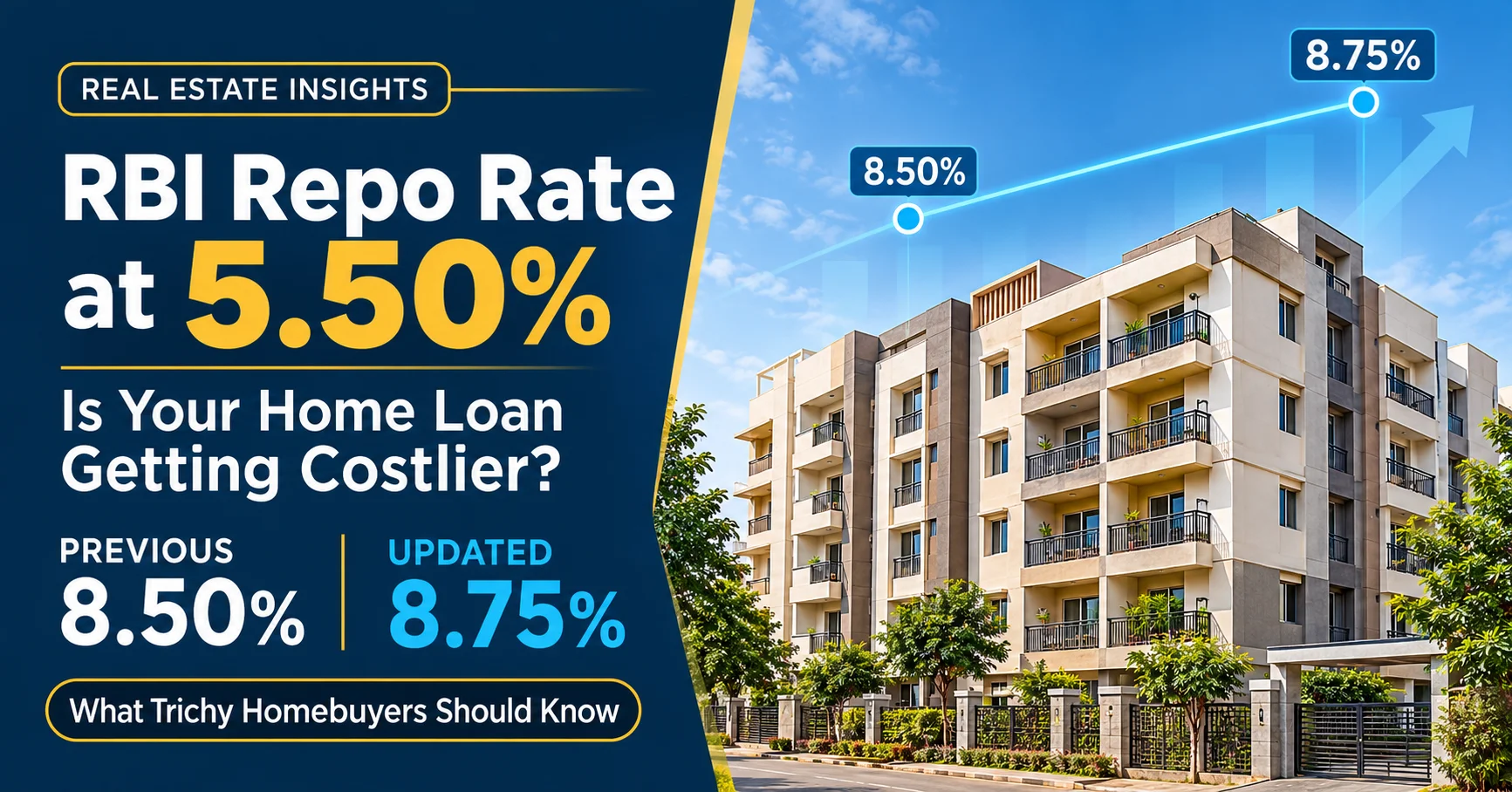
On October 7, 2026, the RBI raised the repo rate by 0.25% to 5.50%, its first increase since February 2023. It also shifted to a “calibrated tightening” stance, which signals no rate cuts in the near term. The next review is on 2 to 4 December 2026. If you are planning to buy a flat in Trichy, here is what the hike means for your EMI and how to decide whether to buy now or wait.
If you already have a floating-rate loan: The change applies at your loan’s reset date, not immediately. One analysis expects it to reach most borrowers by January, or sooner. Some loans are linked to a benchmark other than the repo rate, so check your agreement. When the rate rises, you may see a higher EMI, a longer tenure, or both.
If you are about to take a loan: Banks have already started raising rates. PNB, for example, moved its repo-linked rate from 8.10% to 8.35%. Your rate is fixed when the bank sanctions your loan, and the offer varies by lender.
The average home loan rate in 2026 was reported at about 8.50%. Here is what a rise to 8.75% does on a 20-year loan. These are our calculations, so your bank’s figures may differ.
| Loan | EMI at 8.50% | EMI at 8.75% | Extra per month | Extra interest over 20 years |
|---|---|---|---|---|
| ₹30 lakh | ₹26,035 | ₹26,511 | ₹476 | ₹1.14 lakh |
| ₹50 lakh | ₹43,391 | ₹44,186 | ₹795 | ₹1.91 lakh |
| ₹70 lakh | ₹60,748 | ₹61,860 | ₹1,112 | ₹2.67 lakh |
The average home loan rate in 2026 was reported at about 8.50%. Here is what a rise to 8.75% does on a 20-year loan. These are our calculations, so your bank’s figures may differ.
One comparison site lists home loan rates starting from 7.40% in November 2026, more than 1% below the average and over four times the size of the RBI’s hike. On a ₹50 lakh, 20-year loan, 7.40% gives an EMI of about ₹39,975 against ₹43,391 at 8.50%. That is ₹3,417 less every month, or about ₹8.2 lakh over the loan.
The lowest rates go to borrowers with strong credit profiles, so your offer may differ. Still, written quotes from at least three lenders can save you more than anything the RBI does.
Many buyers stretch the loan to 25 years to lower the EMI. It works, but it is costly. On ₹50 lakh at 8.75%:
| Tenure | EMI | Total interest paid |
|---|---|---|
| 20 years | ₹44,186 | ₹56.0 lakh |
| 25 years | ₹41,107 | ₹73.3 lakh |
You save ₹3,079 a month but pay ₹17.3 lakh more in interest. If you must take the longer tenure, plan to prepay whenever you can.
Say you buy a ₹60 lakh flat with a 20% down payment of ₹12 lakh. Your loan is ₹48 lakh. The EMI would be about ₹41,656 at 8.50%, rising to ₹42,418 at 8.75%.
The down payment is not the only cash you need up front. Stamp duty in Tamil Nadu is 7%, which is ₹4.2 lakh on this property. There is also a registration fee. One source says it has been 2% since April 2023, while others say 4%, so confirm the current rate with the sub-registrar or TNREGINET before you budget. That puts your cash needs at roughly ₹17.4 lakh to ₹18.6 lakh, before interiors, legal checks, loan processing fees and moving costs. Many buyers plan for the down payment and are caught short by the rest.
A common rule of thumb is to keep all EMIs within about 40% of your monthly take-home pay. At 8.75%, that means roughly ₹66,000 monthly income for a ₹30 lakh loan, ₹1.1 lakh for ₹50 lakh, and ₹1.55 lakh for ₹70 lakh. Banks use their own criteria.
Then stress-test it. Add ₹2,000 to your EMI and check whether your monthly budget still holds without touching savings. If it doesn’t, the loan is too large for you.
No one can say where rates go next, and this is not financial advice. Here is how to weigh it.
Going ahead makes sense if:
Waiting makes sense if:
Small extra payments shorten the loan a lot. On ₹50 lakh at 8.75% over 20 years:
| Extra per month | Loan ends in | Interest saved |
|---|---|---|
| ₹1,000 | About 18.9 years | About ₹3.8 lakh |
| ₹2,000 | About 17.9 years | About ₹7 lakh |
| ₹5,000 | About 15.5 years | About ₹14.5 lakh |
Lenders cannot charge a prepayment fee on floating-rate loans taken by individuals for non-business purposes if sanctioned or renewed on or after January 1, 2026. Fixed-rate loans may still carry charges, so check your sanction letter.
The bank usually releases your loan in stages as construction progresses, so you pay interest only on the amount released so far. Get the stage-wise payment schedule from your bank and builder in writing. Also check the project’s RERA registration before paying anything.
Run your numbers in our [Home Loan EMI Calculator], collect three written quotes, and ask for the full cost sheet including registration and other charges. For project details and availability, Contact Us.
This article is general information, not financial, tax or legal advice. Confirm rates, fees and eligibility with your bank before deciding.